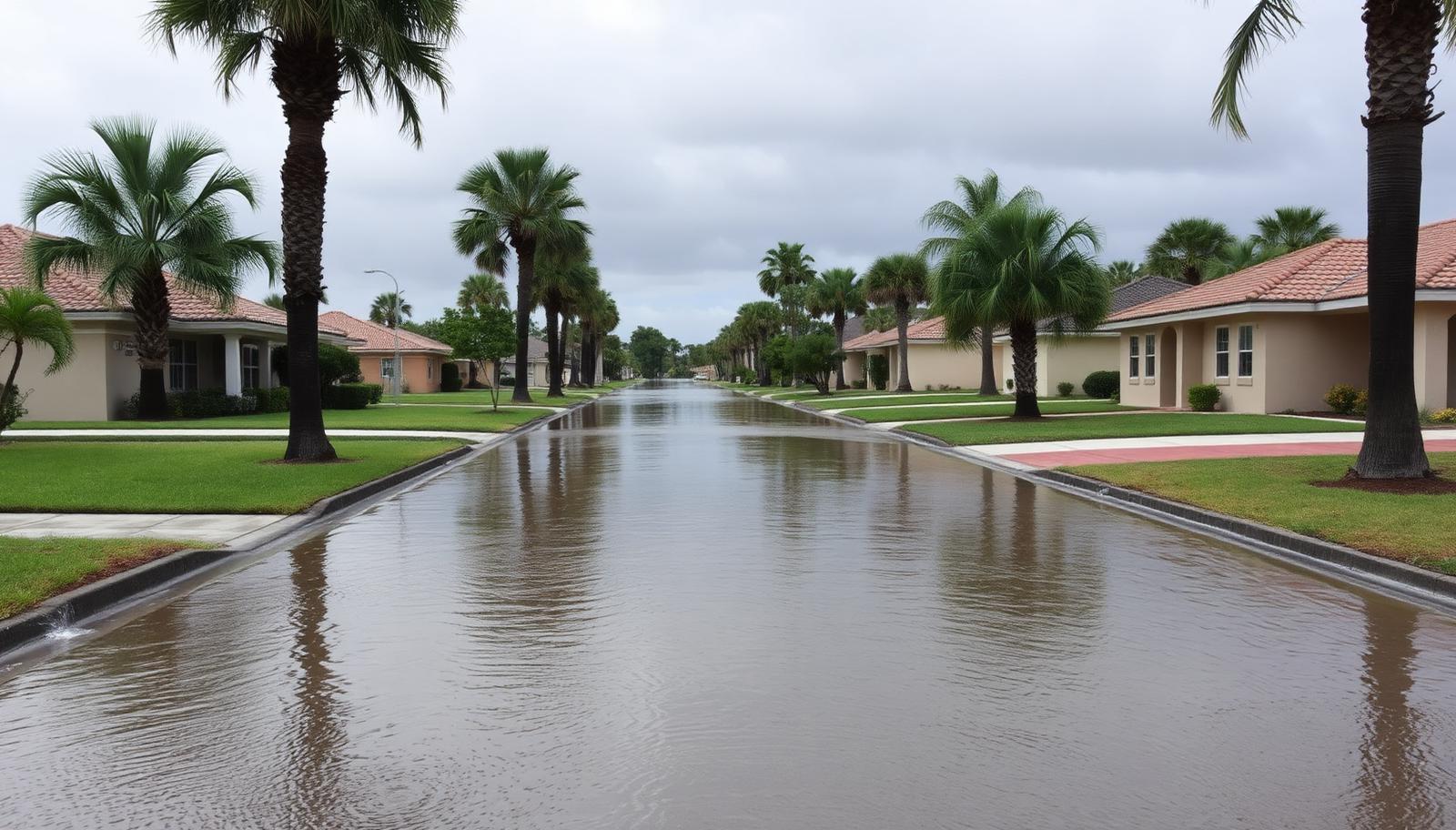
If you own a home in Florida, you've probably wondered how much flood insurance costs. Unfortunately, there isn't one Florida-wide price that gives every homeowner a useful answer. One property may qualify for relatively inexpensive Florida flood insurance, while another home only a few miles away could cost substantially more to insure.
That's because modern flood insurance pricing considers much more than whether a property is simply "in a flood zone." Under the National Flood Insurance Program's current pricing approach, FEMA evaluates the individual flood risk of the property using factors such as type of flood risk, distance from a flooding source, frequency of flooding, property elevation, building characteristics, and the cost to rebuild the home — rather than relying only on the traditional flood-zone designation. Private flood insurance companies may use their own underwriting models and pricing methods.
For Florida homeowners, that means the best way to know your actual cost is to obtain a personalized quote. Still, understanding what determines how much flood insurance costs in Florida can help you anticipate why one property may cost more than another and identify ways you might be able to reduce your premium.
Is There an Average Cost for Flood Insurance in Florida?
You'll find plenty of websites claiming to provide an "average Florida flood insurance cost." Be careful with those numbers. An average can be interesting, but it isn't necessarily useful for predicting what your home will cost to insure.
Florida contains dramatically different flood exposures. Consider the difference between:
- A waterfront home in Miami Beach
- A house near a canal in Fort Lauderdale
- An elevated home in the Florida Keys
- A suburban property in Orlando
- A home several miles inland in Gainesville
Even two houses in the same ZIP code may have different premiums because of differences in elevation, construction, rebuilding value, and distance from flood sources. FEMA's current pricing system intentionally evaluates individual property characteristics rather than applying one generalized price based solely on the FEMA flood zone. That's why personalized quotes are far more meaningful than statewide averages.
Why Does Flood Insurance Cost More for Some Florida Homes?
Flood insurance is based on risk. The greater the expected flood risk and potential severity of a loss, the more an insurer may need to charge. Several factors can influence your premium.
1. Your Property's Flood Risk
The likelihood of flooding is one of the biggest factors. FEMA's NFIP pricing methodology considers multiple types of flood exposure, including risks associated with:
- Coastal flooding
- Storm surge
- Heavy rainfall
- Rivers
- Inland flooding
A home with greater expected flood frequency or severity may have a higher premium. FEMA describes Risk Rating 2.0 as an approach designed to more accurately reflect an individual property's flood risk.
2. Distance From Water
How close your property is to a potential flood source can affect pricing. That may include proximity to the ocean, a bay, a river, a canal, a lake, or another flood source.
But distance alone doesn't determine your premium. Elevation and local geography also matter. A waterfront property built high above expected flood levels may present a very different risk from a lower property located farther inland.
3. Property Elevation
Elevation can have a major impact on flood risk. The important question isn't simply "how high above sea level is my house?" It's how the insured structure's elevation compares with expected floodwater levels in that area.
FloodSmart advises homeowners that documenting a property's elevation with an Elevation Certificate may help determine whether certain mitigation features or elevation characteristics can reduce flood insurance costs. An elevated home may experience lower expected flood damage than an otherwise similar structure built close to ground level.
4. Foundation Type
How your home is built can also affect its vulnerability to flooding. Examples include homes constructed on:
- Slabs
- Crawl spaces
- Piers
- Pilings
- Elevated foundations
FEMA's mitigation tools consider building characteristics because some construction methods can reduce flood damage. For Florida coastal properties, elevation and foundation design can be particularly important.
5. Cost to Rebuild the Home
Under FEMA's current pricing methodology, a property's replacement cost can influence the premium. That makes sense — a home that could cost $800,000 to reconstruct represents a greater potential insured loss than one that would cost $250,000 to rebuild.
FEMA specifically identifies rebuilding cost as one of the factors used in flood insurance pricing. This is another reason two neighboring properties may receive different flood insurance quotes. It's also one of the reasons Florida home insurance is so expensive in general.
6. Coverage Limits
The amount of flood insurance you purchase affects your premium. For homeowners, an NFIP policy can provide up to $250,000 in building coverage and $100,000 in contents coverage for a qualifying residential property. Private flood insurers may offer different or higher limits depending on the company and property.
A homeowner purchasing greater protection will generally pay more than someone selecting lower limits. But don't choose limits solely to minimize the premium. Think about what it could actually cost to recover after a major flood.
7. Your Deductible
Flood insurance policies generally include deductibles. Choosing a higher deductible can potentially reduce the annual premium — but you'll be responsible for more money if a claim occurs. A homeowner might compare a $1,000 deductible with a $5,000 deductible. The higher deductible may reduce the premium, but the homeowner would have greater out-of-pocket responsibility after a covered flood loss.
NFIP policies can also have separate deductibles for building coverage and contents coverage. Choose deductibles based on what you could realistically afford after a disaster. Related reading: how insurance deductibles work.
What Is FEMA Risk Rating 2.0?
For many years, flood insurance pricing was closely associated with FEMA flood zones. Under the National Flood Insurance Program's newer pricing methodology, known as Risk Rating 2.0, FEMA uses more property-specific information. Risk Rating 2.0 began rolling out in 2021 and is now the NFIP's standard pricing methodology.
FEMA may consider:
- Flood frequency
- Flood type
- Distance to water
- Elevation
- Building characteristics
- Replacement cost
The goal is to price the individual property's risk more accurately.
Does Your FEMA Flood Zone Still Matter?
Yes — but perhaps not in the way many homeowners think. Flood maps remain important for understanding flood risk, floodplain management, building requirements, and determining whether lenders may require flood insurance.
However, the NFIP no longer calculates premiums using flood zone alone. FEMA states that Risk Rating 2.0 incorporates multiple variables to reflect a property's individual risk. So two properties in the same FEMA flood zone may pay different premiums.
High-Risk Flood Zones
Properties in FEMA-designated Special Flood Hazard Areas generally face a greater statistical probability of flooding. These areas can include zones such as A, AE, V, and VE, depending on the specific flood hazard.
Homes with federally backed mortgages in certain high-risk areas may be subject to mandatory flood insurance purchase requirements. But don't assume that only these properties flood.
What If My House Isn't in a High-Risk Flood Zone?
You can still purchase flood insurance — and it may still be worth considering. FEMA has historically reported that a meaningful share of NFIP claims originate outside high-risk Special Flood Hazard Areas; one FEMA educational document says about 40% of NFIP claims on average have come from outside these high-risk zones. FloodSmart's current consumer materials likewise emphasize that flooding can occur outside high-risk zones.
Florida residents can experience flooding from:
- Extreme rainfall
- Tropical storms
- Drainage problems
- Canal overflow
- Hurricanes
- Rapid development
- Localized street flooding
"Lower risk" does not mean "no risk." Skipping flood coverage because a lender didn't require it is one of the most common — and most expensive — insurance mistakes Florida residents make.
Why Florida Flood Zones Aren't the Whole Story
South Florida provides a good example. A property may not sit directly on the ocean but could be affected by nearby canals, low elevation, drainage capacity, heavy rainfall, high groundwater, or storm surge moving through waterways.
FloodSmart notes that flood risk can change over time because of development, erosion, weather patterns, and other factors. That's why homeowners should consider both the official flood map and the property's broader risk.
NFIP vs. Private Flood Insurance in Florida
Florida homeowners may have two major sources of flood insurance. The National Flood Insurance Program is administered by FEMA and sells policies through participating insurers and agents. Private flood insurance companies may also offer flood policies.
Depending on the property, private flood insurance may provide:
- Different pricing
- Higher limits
- Additional coverage options
- Different deductibles
However, private policies vary considerably. The cheapest option isn't automatically the best one — compare what each policy actually covers.
Does the Insurance Company Affect the Price of an NFIP Policy?
NFIP pricing is established by the federal program. FloodSmart notes that NFIP rates are unique to the property's location and coverage needs rather than varying based on which participating provider writes the NFIP policy. In other words, you generally shouldn't expect one NFIP provider to offer the exact same NFIP policy at half the federally determined rate.
Where comparison shopping becomes more interesting is when private flood insurance is also available. An independent insurance agency may be able to help compare available NFIP and private-market options.
NFIP Building Coverage
For qualifying residential properties, NFIP building insurance can provide up to $250,000 of coverage. Building coverage may apply to qualifying:
- Foundation
- Electrical systems
- Plumbing
- HVAC
- Water heaters
- Certain appliances
- Permanently installed property
All subject to NFIP policy terms.
NFIP Contents Coverage
NFIP policies can provide up to $100,000 in residential contents coverage. This may protect qualifying belongings such as furniture, clothing, electronics, certain appliances, and other personal property, subject to policy limits and exclusions.
Contents insurance isn't necessarily automatically included simply because you purchased building coverage. Review both.
Building and Contents Deductibles
NFIP building and contents coverage may have separate deductibles. That distinction is easy to overlook. For example, imagine a flood causes $60,000 in building damage and $25,000 in contents damage. If both coverages carry separate deductibles, more than one deductible could affect the claim.
Review this when comparing flood insurance deductibles rather than looking only at the total premium.
Private Flood Insurance May Offer Higher Limits
One limitation of NFIP coverage is its maximum residential limits. For a high-value Florida home, $250,000 in building coverage may not be sufficient. Some private insurers may provide higher limits or coverage options designed for homes with greater values.
This can be particularly relevant in areas such as Miami, Miami Beach, Coral Gables, Fort Lauderdale, Palm Beach, Naples, and the Florida Keys, where reconstruction costs can be substantial.
Does Homeowners Insurance Cover Flooding?
Generally, no. Standard homeowners insurance typically excludes flooding caused by rising water. That means homeowners insurance may cover one portion of a hurricane loss while flood insurance covers another.
For example: wind tears shingles from your roof — that may involve your homeowners insurance, depending on the policy. Storm surge enters the first floor — that generally falls into the flood-insurance category.
Understanding that distinction is extremely important. Related reading: Florida homeowners insurance guide and insurance for first-time home buyers in Florida.
Flood Insurance vs. Hurricane Insurance
People sometimes use the terms interchangeably. They shouldn't. A hurricane can cause multiple types of damage: wind, rain, storm surge, flooding, and falling objects.
Different policies may respond to different causes of loss. A homeowners policy isn't a substitute for flood insurance simply because flooding occurred during a hurricane.
Flood Insurance in Miami and South Florida
South Florida has unique flood exposure. Homes in Miami-Dade, Broward, Palm Beach, and Monroe counties may face risks involving coastal flooding, storm surge, canals, heavy rainfall, low elevation, drainage, and high groundwater.
That doesn't mean every South Florida property will have expensive flood insurance. Because current pricing is property-specific, neighboring homes can receive different premiums.
Does Being Near the Ocean Automatically Make Flood Insurance Expensive?
Not necessarily. Proximity to the coast is important, but it's only one factor. A coastal home that is highly elevated and engineered to withstand flooding may have a different risk profile from a lower inland property near a river or canal.
FEMA's pricing methodology specifically considers multiple characteristics rather than simply using distance to the ocean.
Can an Elevation Certificate Lower Your Flood Insurance Cost?
Potentially. An Elevation Certificate provides information about how the structure sits relative to flood elevations. Even though an Elevation Certificate isn't necessarily required for every NFIP policy under Risk Rating 2.0, FEMA says homeowners may provide one if it could help more accurately rate their property.
If your home is favorably elevated, the additional information may help demonstrate reduced flood risk.
Can Flood Mitigation Lower Your Premium?
Potentially. FloodSmart provides a mitigation discount tool that evaluates features that may lower flood risk and insurance pricing. Possible mitigation strategies can include:
- Elevating the building
- Elevating machinery and equipment
- Installing flood openings where appropriate
- Improving certain foundation characteristics
- Relocating equipment from lower levels
Not every modification qualifies for a discount, and the economics should be evaluated before undertaking expensive work solely to reduce insurance premiums.
Community Rating System Discounts
The Community Rating System, or CRS, rewards communities that implement floodplain-management practices exceeding minimum NFIP requirements. Residents of participating communities may receive NFIP premium discounts.
As of 2026, FEMA states that CRS discounts range from 5% to 45%, depending on the community's classification. This is an important example of a factor that can affect what two otherwise similar properties pay in different communities.
Can You Lower Your Flood Insurance Cost by Raising the Deductible?
Potentially. Higher deductibles generally shift more financial responsibility to the homeowner and can reduce premiums. But don't look only at annual savings — compare the annual premium savings against the additional amount you'd have to pay after a flood.
Saving $200 per year isn't necessarily a good trade if it increases your deductible by several thousand dollars and you don't have sufficient emergency savings.
Should You Reduce Coverage to Lower Your Premium?
Be careful. You may be able to reduce premiums by selecting lower coverage limits, but doing so means accepting more financial exposure. Suppose you reduce building coverage substantially to save money, and then a major flood causes far more damage than your policy limit. You'll be responsible for the difference.
Insurance should be affordable — but it also needs to be useful when something goes wrong.
What Does Flood Insurance Not Cover?
Flood policies have exclusions and limitations. Depending on the policy, coverage may be limited or unavailable for:
- Certain basement property
- Landscaping
- Swimming pools
- Outdoor property
- Vehicles
- Currency
- Certain valuable items
- Additional living expenses
NFIP policies in particular have specific coverage rules that differ from ordinary homeowners insurance. Always review what isn't covered.
Does NFIP Flood Insurance Pay Replacement Cost?
Claim settlement depends on the property and coverage requirements. FloodSmart explains that NFIP flood coverage can involve both replacement cost value and actual cash value depending on the circumstances and type of property.
A policy's stated limit doesn't automatically guarantee that the entire limit will be paid after every loss. Claims are settled according to covered damage and policy terms.
What Is Increased Cost of Compliance Coverage?
Certain NFIP policyholders whose properties are substantially or repetitively damaged may qualify for Increased Cost of Compliance, or ICC, benefits. As of 2026, FEMA says qualifying policyholders may receive up to $30,000 toward certain measures needed to bring a property into compliance with current floodplain-management requirements.
Depending on the situation, this can help fund measures such as elevation, relocation, demolition, or certain floodproofing activities, subject to program requirements.
Is Flood Insurance Worth the Cost in Florida?
That depends on the property and your financial situation. A useful way to think about it is: what would happen financially if your home flooded tomorrow? Could you comfortably pay $25,000, $50,000, or $100,000 out of pocket?
FloodSmart currently reports that the average NFIP flood claim payment is about $68,000, illustrating how expensive flood losses can become. For many homeowners, that potential loss is worth insuring even if a lender doesn't require them to purchase coverage.
Can Renters Buy Flood Insurance?
Yes. Renters don't need to insure the building, but they may want flood coverage for personal belongings. Your landlord's flood or property insurance generally isn't intended to replace your furniture, clothing, electronics, or other possessions after a flood.
Contents-only flood coverage may be an option. Related reading: Florida renters insurance guide.
Can Condo Owners Buy Flood Insurance?
Yes. Condo insurance involves additional complexity because the condominium association may maintain flood coverage for certain building property while individual owners remain responsible for their own interests. A unit owner may still need to consider coverage for personal belongings, unit improvements, and other insurable property, depending on the building's master policy.
Related reading: condo insurance Florida guide.
Flood Insurance for Florida Businesses
Businesses can also suffer major flood losses. Commercial property insurance generally shouldn't be assumed to cover rising-water flooding. Business owners may need separate commercial flood insurance for qualifying buildings, equipment, inventory, and business property.
Businesses should also investigate whether a flood-related shutdown could leave an income gap. Related reading: commercial property insurance in Florida.
When Should You Buy Flood Insurance?
Don't wait until a hurricane is approaching. Flood insurance policies may have waiting periods before coverage becomes effective, although exceptions can apply in certain circumstances.
Purchasing coverage after a major storm is already threatening Florida may be too late. Review your flood insurance well before hurricane season becomes active.
How to Get a Florida Flood Insurance Quote
When requesting a quote, be prepared to provide information such as:
- Property address
- Building type
- Year built
- Foundation type
- Number of floors
- Coverage amounts
- Property usage
- Elevation information if available
The insurer will use property-specific information to calculate the premium. Because private flood insurance and NFIP policies can differ, compare more than price.
What Should You Compare Between Flood Insurance Quotes?
- Building coverage
- Contents coverage
- Deductibles
- Policy exclusions
- Replacement cost provisions
- Additional living expense coverage if available
- Waiting periods
- Maximum policy limits
- Carrier type
A $700 policy and a $1,000 policy aren't necessarily comparable if the more expensive policy provides substantially broader protection.
Why Work With an Independent Florida Insurance Agent?
Flood insurance can be confusing because homeowners may have access to both government-backed NFIP coverage and private flood insurance. An independent insurance agent can help you:
- Understand your flood exposure
- Review FEMA flood-zone information
- Obtain an NFIP quote where applicable
- Compare available private flood insurers
- Review deductibles
- Compare policy limits
- Coordinate flood and homeowners coverage
The goal isn't necessarily to find the absolute cheapest policy — it's to find appropriate protection at a competitive price. Related reading: independent insurance agent vs. buying direct.
Frequently Asked Questions About Florida Flood Insurance Costs
How much does flood insurance cost in Florida?
There is no single Florida price. Premiums vary based on individual property risk, location, flood frequency, elevation, construction, replacement cost, coverage limits, deductibles, and the type of policy. FEMA's NFIP uses property-specific Risk Rating 2.0 pricing.
Is flood insurance cheaper outside a high-risk flood zone?
It can be, because lower expected flood risk may reduce pricing. However, NFIP premiums aren't determined solely by the FEMA flood-zone designation.
Does my FEMA flood zone determine my flood insurance price?
Not by itself. Flood zones remain important, but Risk Rating 2.0 considers multiple property-specific risk factors.
Can I get flood insurance if I'm not in a flood zone?
Yes. Properties outside high-risk flood zones can purchase flood insurance and still experience damaging floods.
Can an Elevation Certificate lower my flood insurance?
Potentially. FEMA allows homeowners to provide elevation information that may help accurately reflect the property's flood risk.
Does homeowners insurance include flood coverage?
Standard homeowners insurance generally doesn't cover rising-water flooding. A separate flood policy is usually needed.
What are the NFIP residential coverage limits?
NFIP residential policies can provide up to $250,000 of building coverage and $100,000 of contents coverage for qualifying properties.
Are private flood policies cheaper than NFIP insurance?
Sometimes, depending on the property and insurer. Other times NFIP coverage may be more competitive. Compare both price and policy terms when available.
Can I lower my flood premium by increasing my deductible?
Potentially, but doing so increases the amount you'll pay out of pocket after a covered flood loss.
Do I need flood insurance if my lender doesn't require it?
Not necessarily as a lending requirement, but that doesn't mean your property has no flood risk. Whether to purchase coverage should depend on your exposure and ability to absorb a major flood loss.
The Only Reliable Way to Know Your Cost Is to Get a Quote
So, how much does flood insurance cost in Florida? The answer depends on your property. Modern flood insurance pricing looks at far more than a simple flood-zone letter. Factors can include flood frequency, distance from water, property elevation, foundation type, replacement cost, coverage limits, deductibles, and community mitigation.
And if private flood insurance is available, you may have additional pricing and coverage options beyond the NFIP. That's why generic statewide averages should be treated as a rough reference — not as a prediction of what you'll pay.
At Tammy Insurance, we help Florida homeowners, condo owners, renters, and businesses understand their flood insurance options, compare available coverage, and determine which deductibles and limits make sense for their situation. Whether you live on the coast, near a canal, or miles inland, we're here to help you understand your risk before the next major storm arrives.
Want to know what flood insurance would actually cost for your Florida property? Contact Tammy Insurance today for a personalized flood insurance quote and coverage review.